286days left

Nansha Forges a High-End Medical and Health Industry Growth Pole in Southern Guangzhou
Author:广州医博会
Time:2025-12-23
Reader:1438
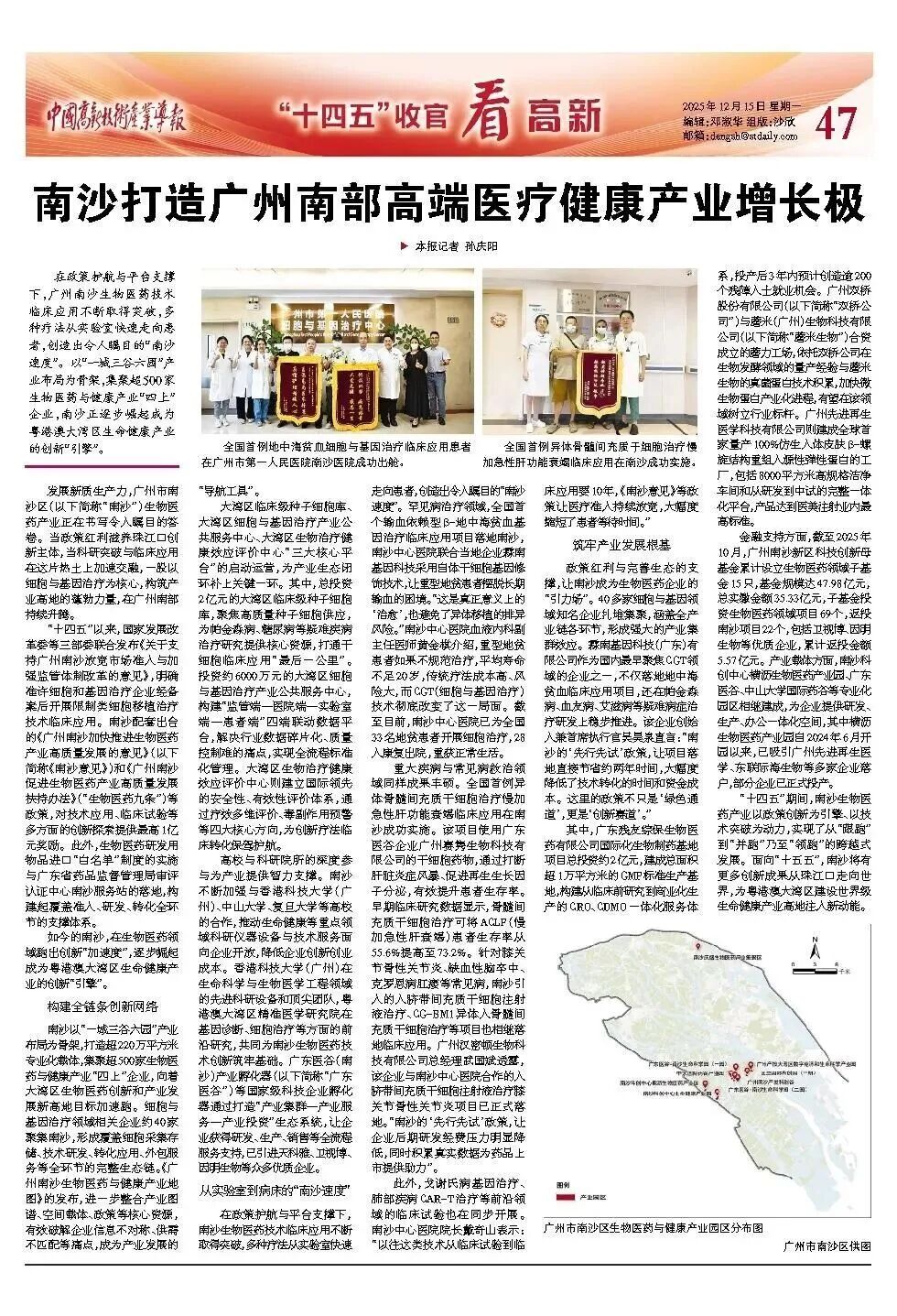
With policy support and platform backing, the clinical application of biomedical technologies in Guangzhou Nansha has continuously achieved breakthroughs. Various therapies are rapidly moving from the laboratory to patients, creating a remarkable "Nansha Speed." Framed by the "One City, Three Valleys, Six Parks" industrial layout and home to over 500 biomedical and health industry enterprises above designated size ("Four Categories" enterprises), Nansha is gradually emerging as an innovation "engine" for the life and health industry in the Guangdong-Hong Kong-Macao Greater Bay Area.
In developing new quality productive forces, the biomedical industry of Guangzhou's Nansha District (hereinafter referred to as Nansha) is writing an impressive report card. As policy dividends nourish innovative entities at the Pearl River Estuary, and as scientific breakthroughs and clinical applications accelerate their integration on this fertile ground, a vigorous force, centered on cell and gene therapy and aiming to build an industrial highland, is continuously surging in southern Guangzhou.
Since the 14th Five-Year Plan period, three national ministries, including the National Development and Reform Commission, jointly issued the "Opinions on Supporting Guangzhou Nansha in Relaxing Market Access and Strengthening Regulatory System Reform," explicitly permitting cell and gene therapy enterprises to conduct clinical applications of restricted category cell transplantation technologies after filing. Nansha introduced supporting policies such as the "Opinions of Guangzhou Nansha on Accelerating the High-Quality Development of the Biomedical Industry" (hereinafter referred to as the "Nansha Opinions") and the "Measures of Guangzhou Nansha to Promote High-Quality Development of the Biomedical Industry" ("Biomedical Nine Articles"), providing rewards of up to 100 million yuan for innovative exploration in areas like technology application and clinical trials. Furthermore, the implementation of the import "white list" system for biomedical research and development items and the establishment of the Guangdong Provincial Medical Products Administration Evaluation and Certification Center Nansha Service Station have built a support system covering the entire chain from market access to R&D and commercialization.
Today's Nansha is achieving an innovation "acceleration" in the biomedical field, gradually rising to become an innovation "engine" for the life and health industry in the Greater Bay Area.
I. Building a Full-Chain Innovation Network
With the "One City, Three Valleys, Six Parks" industrial layout as its framework, Nansha has created over 2.2 million square meters of specialized facilities, attracted over 500 biomedical and health industry "Four Categories" enterprises, and is accelerating towards its goal of becoming a new highland for biomedical innovation and industrial development in the Greater Bay Area. Approximately 40 cell and gene therapy-related enterprises have gathered in Nansha, forming a complete ecosystem covering all stages from cell collection and storage, technology R&D, and clinical translation to outsourcing services. The release of the "Guangzhou Nansha Biomedical and Health Industry Map" further integrates core resources such as the industrial landscape, spatial carriers, and policies, effectively addressing pain points like information asymmetry and supply-demand mismatch among enterprises, serving as a "navigation tool" for industrial development.
The launch and operation of the "three core platforms" – the Greater Bay Area Clinical-Grade Seed Cell Bank, the Greater Bay Area Cell and Gene Therapy Industry Public Service Center, and the Greater Bay Area Biotherapy Health Effect Evaluation Center – have filled a crucial gap in the industrial ecological loop. Among them, the Greater Bay Area Clinical-Grade Seed Cell Bank, with a total investment of 200 million yuan, focuses on supplying high-quality seed cells, providing core resources for research on treating difficult diseases like Parkinson's and diabetes, and bridging the "last mile" for stem cell clinical applications. The approximately 60 million yuan-invested Greater Bay Area Cell and Gene Therapy Industry Public Service Center has built a "regulatory-hospital-laboratory-patient" four-end linkage data platform, addressing industry pain points like data fragmentation and quality control difficulties, and achieving standardized management of the entire process. The Greater Bay Area Biotherapy Health Effect Evaluation Center has established internationally advanced safety and efficacy evaluation systems. Through four core directions including multi-dimensional efficacy evaluation and adverse reaction early warning, it safeguards the clinical translation of innovative therapies.
The deep involvement of universities and research institutes provides intellectual support for the industry. Nansha continuously strengthens cooperation with institutions like The Hong Kong University of Science and Technology (Guangzhou), Sun Yat-sen University, and Fudan University, promoting the opening of scientific research instruments, equipment, and technical services in key areas like life sciences to enterprises, thereby reducing their innovation and entrepreneurship costs. The advanced research equipment and top-tier teams in life sciences and biomedical engineering at HKUST(GZ), along with the cutting-edge research in gene diagnosis and cell therapy at the Greater Bay Area Institute of Precision Medicine (Guangzhou), jointly solidify the foundation for Nansha's biomedical technological innovation. National-level technology business incubators like Guangdong Medical Valley (Nansha) Industrial Incubator (hereinafter "GMV Nansha") create a "industrial cluster-industrial service-industrial investment" ecosystem, enabling enterprises to obtain full-process service support from R&D to production and sales. They have attracted numerous high-quality enterprises such as Tencure, Weishibo, and Inming Biotech.
II. The "Nansha Speed" from Lab to Bedside
Under the escort of policies and support of platforms, the clinical application of biomedical technologies in Nansha continues to break through. Various therapies are rapidly moving from the laboratory to patients, creating a remarkable "Nansha Speed." In the field of rare disease treatment, the country's first clinical application project of gene therapy for transfusion-dependent β-thalassemia was implemented in Nansha. Nansha Central Hospital, collaborating with local enterprise LinNan Gene Tech, used autologous stem cell gene modification technology to free patients with severe thalassemia from long-term blood transfusion dependence. "This is a true 'cure,' also avoiding the rejection risks of allogeneic transplantation," explained Dr. Huang Jinqi, Deputy Chief Physician of the Department of Hematology at Nansha Central Hospital. Without standardized treatment, the average life expectancy of severe thalassemia patients is less than 20 years, while traditional therapies are costly and risky. CGT (cell and gene therapy) technology has completely changed this situation. To date, Nansha Central Hospital has performed cell therapy for 33 thalassemia patients nationwide, with 28 recovering and being discharged, regaining normal lives.
Substantial achievements have also been made in the treatment of major and common diseases. The country's first clinical application of allogeneic bone marrow mesenchymal stem cells for treating acute-on-chronic liver failure (ACLF) was successfully implemented in Nansha. This project used stem cell drugs from GMV Nansha enterprise Guangzhou Saijun Biotech Co., Ltd., which effectively improve patient survival rates by interrupting the liver inflammatory storm and promoting the secretion of regenerative growth factors. Early clinical research data shows that bone marrow mesenchymal stem cell treatment can increase the survival rate of ACLF patients from 55.6% to 73.2%. For common diseases like knee osteoarthritis, ischemic stroke, and Crohn's disease anal fistula, projects such as human umbilical cord mesenchymal stem cell injection therapy and CG-BM1 allogeneic human bone marrow mesenchymal stem cell therapy introduced by Nansha have also landed in clinical application. Mr. Wu Guobin, General Manager of Guangzhou Hamilton Biotech Co., Ltd., revealed that the human umbilical cord mesenchymal stem cell injection therapy project for knee osteoarthritis, a collaboration between his company and Nansha Central Hospital, has officially commenced. "Nansha's 'pioneering and piloting' policies have significantly reduced the financial pressure on later-stage R&D for enterprises while accumulating real-world data to aid drug registration."
Furthermore, clinical trials in frontier areas like gene therapy for Gaucher disease and CAR-T therapy for lung diseases are also underway. Dr. Dai Qishan, President of Nansha Central Hospital, stated, "In the past, such technologies took 10 years from clinical trial to clinical application. Policies like the 'Nansha Opinions' have continuously relaxed market access, significantly shortening patient waiting times."
III. Strengthening the Foundation for Industrial Development
The support of policy dividends and a well-developed ecosystem has made Nansha a "gravitational field" for biomedical enterprises. Over 40 renowned enterprises in the cell and gene field have clustered here, covering all links of the industrial chain and forming a powerful industrial cluster effect. LinNan Gene Tech (Guangdong) Co., Ltd., as one of the earliest domestic enterprises focused on the CGT field, has not only implemented the thalassemia clinical application project but is also steadily advancing R&D for treating difficult diseases like Parkinson's, hemophilia, and AIDS. Its founder and CEO, Wu Haoquan, stated frankly, "Nansha's 'pioneering and piloting' policies saved about two years for project implementation, greatly reducing the time and capital costs of technology translation. The policies here are not just a 'green channel' but an 'innovation track'."
Among them, the Guangdong Canyou Zongbao Biomedicine Co., Ltd. international biopharmaceutical base project involves a total investment of approximately 200 million yuan. It will construct a GMP-standard production base covering over 10,000 square meters, building an integrated CRO and CDMO service system from preclinical research to commercial production. Within three years of operation, it is expected to create over 200 employment opportunities for persons with disabilities. The "Moli Workshop" jointly established by Guangzhou Shuangqiao Co., Ltd. (hereinafter "Shuangqiao Company") and Momi (Guangzhou) Biotech Co., Ltd. (hereinafter "Momi Biotech") leverages Shuangqiao Company's experience in large-scale bio-fermentation and Momi Biotech's accumulation in fungal protein technology to accelerate the industrialization process of microbial protein, potentially setting a benchmark in this field. Guangzhou Advanced Regenerative Medicine Technology Co., Ltd. has built the world's first factory capable of mass-producing 100% bionic human skin β-helix structured recombinant human elastin, including 8,000 square meters of high-specification clean rooms and a complete integrated platform from R&D to pilot production, with products meeting the highest standards in the aesthetic injection industry.
Regarding financial support, as of October 2025, the Guangzhou Nansha New Area Science and Technology Innovation Mother Fund has cumulatively established 15 sub-funds in the biomedical field, with a fund scale of 4.798 billion yuan and total paid-in capital of 3.533 billion yuan. These sub-funds have invested in 69 biomedical projects, with 22 projects invested back into Nansha (including high-quality enterprises like Weishibo and Inming Biotech), with a cumulative reinvestment amount of 557 million yuan. In terms of industrial carriers, specialized parks such as the Nansha Science and Innovation Center Hengli Biomedical Industrial Park, Guangdong Medical Valley, and Sun Yat-sen University International Medicine Valley have been successively completed, providing enterprises with integrated R&D, production, and office space. Among them, since its opening in June 2024, the Hengli Biomedical Industrial Park has attracted several enterprises including Guangzhou Advanced Regenerative Medicine and Donglian Jihai Biotech to settle, with some already commencing production.
During the 14th Five-Year Plan period, Nansha's biomedical industry, driven by policy innovation and powered by technological breakthroughs, achieved leapfrog development from "catching up" to "running abreast" and even "leading the way." Looking ahead to the 15th Five-Year Plan period, more innovative achievements from Nansha will move from the Pearl River Estuary to the world, injecting new momentum into the Greater Bay Area's construction of a world-class life and health industry highland.
• END •
Source | China High-Tech Industry Herald
Correspondents | Li Zizi, Lan Xiyu
Editor | Chen Biyi
Prev Overtaking on the Curve! The Biopharmaceutical "Huangpu Corps" Accelerates Its Rise
Next Just now! Guangzhou released the full text, with huge amount of information.
相关推荐
- Bay Area Connects Globally, Innovation Drives Health | 2026 Guangzhou Medical Expo Invites You to Attend This Grand Event 2026-05-22
- 2026 Guangzhou Medical Expo Scheduled for August! Building the Core Engine for the Greater Bay Area's Healthcare Industry. 2025-11-07
- Full-chain Empowers Industrial Innovation! The 2025 Guangzhou Medical Expo Successfully Concludes Today 2025-08-24
- Grand Opening of 2025 Guangzhou Medical and Health Industry Expo: Jointly Paint a New Blueprint for Health and Play the March of Industrial Endeavor 2025-08-22
-
Exhibition Overview
Exhibition IntroductionOrganizationExhibition RangeExhibition Promotion -
Media Center
Exhibition DynamicsIndustry NewsExhibition PhotoExhibition VideoPartner -
Audience Center
Visit ScheduleVip Registration -
Exhibitor Center
Why To ExhibitScheduleExhibition Floor PlainBooth ReservationDownload Center -
Concurrent Activities
Forum activitiesRoadshowCompany Promotion -
Business Travel Service
City IntroductionExhibition HallSightseeingHotel ReservationTraffic Guide -
Contact Us
About UsContact Us
Copyright Guangdong Silver Age Health Industry Co. Ltd.
粤ICP备2021159608号-6
 粤公网安备44010502003694号
TEL:+86 020-38109036 E-mail:eld@eldexpo.com Add:Yinfa Chain Global Selection Center, No. 192 Kaitai Avenue, Huangpu District, Guangzhou.