286days left

Circular of the State Council on Issuing the National Health Plan for the 15th Five-Year Plan Period
Author:广州医博会
Time:2026-07-14
Reader:717

National Health Plan for the 15th Five-Year Plan Period
This Plan is formulated to implement the health-first development strategy and accelerate the building of a Healthy China, in accordance with the Outline of the 15th Five-Year Plan for National Economic and Social Development of the People's Republic of China and the Outline of the Healthy China 2030 Initiative.
I. General Requirements
We will follow the guidance of Xi Jinping Thought on Socialism with Chinese Characteristics for a New Era, thoroughly implement the spirits of the 20th CPC National Congress and all plenary sessions of the 20th CPC Central Committee, earnestly deliver on the arrangements of the Fourth Plenary Session, unswervingly pursue a Chinese path to health and medical development, and faithfully apply the Party’s health work guidelines for the new era. Centered on high-quality development of health and medical undertakings, this Plan takes improving the integrated whole-life-cycle health service system for all as the main line, and reform and innovation as the fundamental driving force. Driven by digital and intelligent transformation and integrated Chinese and Western medicine, we will shift medical and health development toward a health-centered model, upgrade service systems for better quality and efficiency, and advance systematic and coordinated governance through reforms. We will boost the equity and accessibility of health services, encourage people to take proactive care of their health, foster lifestyles and economic and social development models conducive to health, comprehensively raise the national health level, and consolidate the health foundation for Chinese modernization.
By 2030, an institutional framework for the health-first development strategy will be basically established, health promotion policies and institutions will be further refined, and the basic medical and healthcare system with Chinese characteristics will be improved. Capabilities for public health security, primary-level disease prevention, treatment and health management will be markedly enhanced, the allocation of medical and health resources will be optimized, and the multi-tiered medical security system will be further upgraded. An integrated development framework for education, science, technology and talent geared to people’s life and health will take shape. China’s leading role in the development of traditional medicine worldwide will be further consolidated, and decisive progress will be made in advancing the Healthy China Initiative. Healthy lifestyles will gain widespread popularity, the rising incidence of major chronic diseases will be effectively curbed, average life expectancy will reach 80 years, and major health indicators will match those of high-income economies, laying a solid foundation for building a Healthy China by 2035.
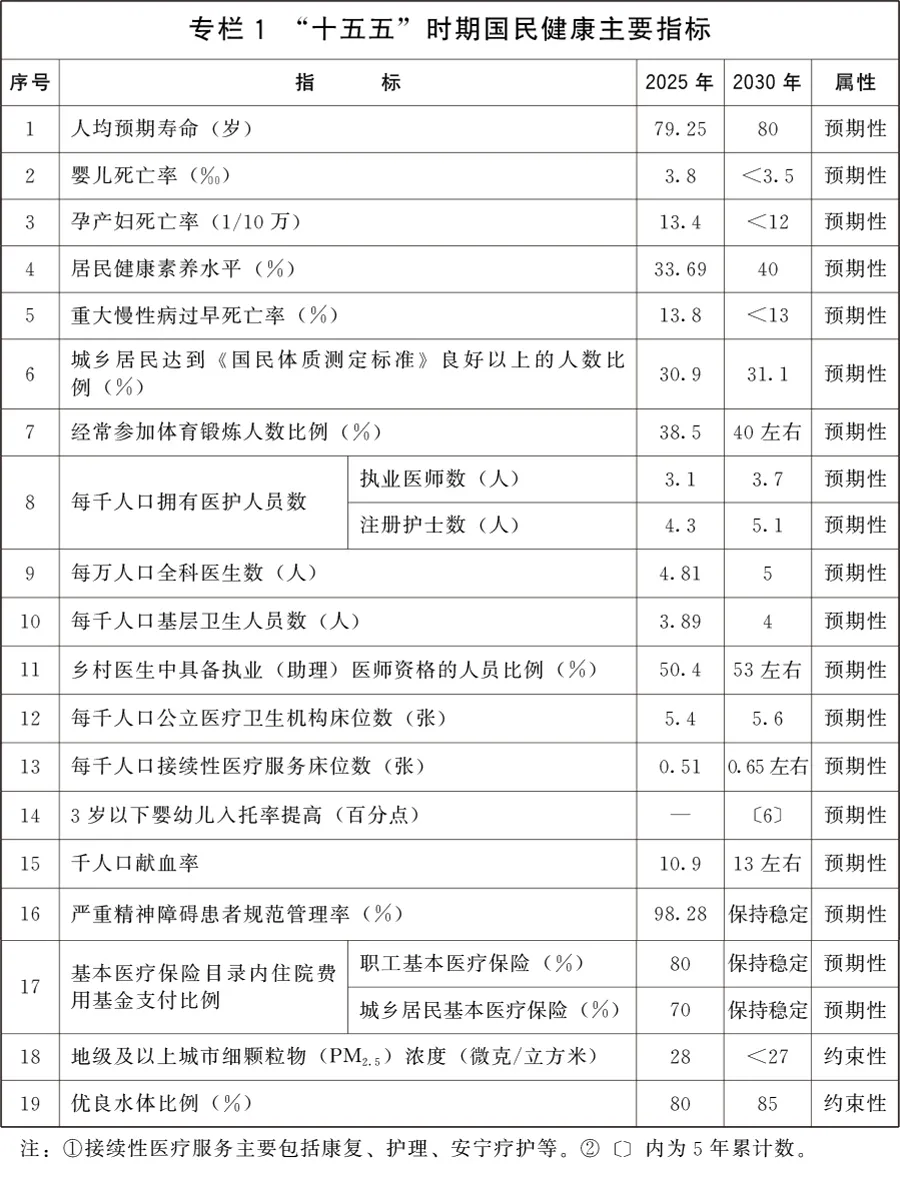
II. Optimize All-Round, Whole-Life-Cycle Health Services for All Populations
(I) Strengthen Health Promotion and Disease Prevention
We will incorporate health education into the national education system and build platforms for health education and science popularization. We will advocate healthy and civilized lifestyles, launch rational nutrition and healthy weight management campaigns, and mobilize the whole society to cut salt, oil and sugar intake. We will carry out the National Nutrition Program, refine nutrition and health standards, deploy more nutrition instructors, and scale up nutrition interventions for key groups. We will advance smoke-free environments and expand smoking cessation services, lowering the smoking rate among people aged 15 and above to 20%. We will roll out family health promotion initiatives, launch extensive national fitness programs, and build more sports and fitness venues accessible to the public. We will popularize traditional Chinese medicine (TCM) wellness therapies. We will strengthen monitoring of chronic diseases and their risk factors, develop full-chain prevention, treatment and rehabilitation services, improve the early screening, diagnosis and treatment system, set up integrated outpatient clinics for chronic diseases, and implement coordinated prevention, treatment and management of multiple illnesses. We will step up prevention and control of major infectious diseases including AIDS, tuberculosis and viral hepatitis, and curb or eliminate hazards from key parasitic and endemic diseases. We will improve the social psychological service system and crisis intervention mechanisms, expand the use of the 12356 psychological assistance hotline, deliver comprehensive services for patients with severe mental disorders, and develop community rehabilitation for mental illnesses. We will launch injury prevention and control programs, conduct health risk assessments of ecological environments in key regions, and carry out initiatives to adapt to health impacts of climate change.
(II) Improve Whole-Life-Cycle Health Services
Reproductive, Maternal and Infant Care
We will refine maternity and infant care services and improve the policy system supporting childbirth. We will protect fertility, standardize diagnosis and treatment for infertility, launch early pregnancy care programs and initiatives to boost capacity for birth defect prevention and treatment, regulate the application of assisted reproductive technology, and expand medical insurance coverage for eligible assisted reproductive treatments. We will promote labor analgesia and reasonably raise insurance reimbursement for prenatal checkups and labor analgesia during in-hospital delivery. We will strengthen emergency treatment for critically ill pregnant women and newborns, build more maternity-friendly hospitals and upgrade wards for obstetrics and infants. We will accelerate the development of an inclusive childcare service system.
Women’s and Children’s Health
We will optimize women’s health services, expand screening and early diagnosis and treatment for breast and cervical cancers, and fully provide free HPV vaccination for school-age girls as part of national immunization programs. We will upgrade pediatric medical and healthcare services, improve early childhood development support, strengthen sex and reproductive health education for adolescents, launch campaigns to boost children and adolescents’ health covering weight, eyesight, mental health, bone development and oral health, and advance early screening and intervention for autism. We will build more child-friendly hospitals.
Occupational Health Protection
We will carry out special governance on occupational hazards in key industries, identify and assess occupational hazards in emerging industries and new business forms, build intelligent monitoring and early warning networks, and formulate comprehensive prevention and control strategies for work-related illnesses. We will develop healthy enterprises.
Elderly Health Services
We will launch initiatives targeting elderly oral health, hearing care, psychological support, nutrition improvement and dementia prevention, and strengthen rational medication guidance for seniors. We will build general hospitals specializing in geriatric medicine, roll out demonstration programs integrating medical and elderly care, advance community-supported home-based elderly care, expand health management, home medical visits and home hospital bed services, and improve the care system for disabled and dementia-affected seniors.
Health Services for People with Disabilities and Low-Income Groups
We will implement a new national disability prevention action plan, strengthen health management and rehabilitation services for persons with disabilities, carry out blindness and deafness prevention and treatment, scale up rehabilitation assistance for disabled children, and build disability-friendly medical institutions. We will improve regular monitoring and support mechanisms to prevent medical impoverishment, and support accelerated development in key counties targeted for rural revitalization.
(III) Elevate the Quality of Medical Services
We will strengthen medical quality management, refine the medical quality control system, and explore coordinated quality control across regions such as the Beijing-Tianjin-Hebei Region and the Yangtze River Delta. We will launch campaigns to improve medical quality at primary-level medical and health institutions, formulate and revise clinical guidelines and standards, and raise the share of inpatients covered by clinical pathway management. Hospitals at secondary and above levels will fully roll out high-quality nursing and companion-free inpatient care services. We will upgrade pharmaceutical services and strengthen continuous medication management for residents.
We will reorient services around health. We will reasonably adjust per capita fiscal subsidies for basic public health services, optimize service items, and enhance primary-level chronic disease management. Secondary and higher hospitals are encouraged to set up specialized outpatient clinics for weight management, mental health, sleep disorders and vaccination. Eligible medical institutions may establish obesity prevention and health management centers. We will explore integrated diagnosis and treatment of organs and systems, develop multi-disciplinary teams, and improve comprehensive disease treatment capacity.
We will accelerate tiered medical diagnosis and treatment. We will build compact medical consortiums featuring integrated medical operation and information management to homogenize medical services. We will advance high-quality contracted family doctor services and boost coverage and satisfaction rates. We will improve the first-contact medical care system and referral mechanisms, build referral and consultation centers in all prefecture-level cities for secondary and higher hospitals, prioritize outpatient appointments from secondary and higher hospitals for primary-level institutions, and guide rational medical seeking behavior.
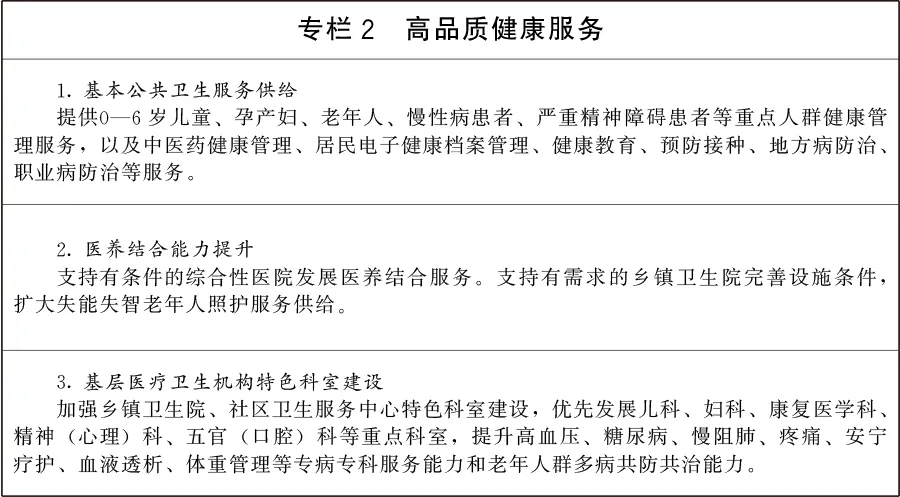
III. Continuously Build a High-Caliber Safeguard Barrier for Medical and Health Security
(I) Boost Capacity for Prevention and Control of Major Infectious Disease Outbreaks
We will improve joint prevention and control mechanisms for major infectious disease outbreaks, deepen multi-stakeholder governance and integration of clinical and disease prevention services, implement a community-based disease prevention and control responsibility system, and facilitate personnel exchange, cross-training, integrated services and information sharing between medical institutions and professional public health bodies. A disease prevention and control supervisor system will be established. We will strengthen prevention and response to cross-species transmission of novel pathogens, upgrade infectious disease monitoring, early warning and epidemiological investigation capabilities, and enhance cross-departmental coordination and information sharing. A full-fledged system covering infectious disease prevention and control, emergency response, medical treatment, material supply and supervision will be established.
(II) Improve Emergency Medical Treatment and Blood Supply Capacity
We will refine standards for pre-hospital emergency care, create integrated pre-hospital and in-hospital green channels, strengthen information connectivity, and advance integrated emergency care systems. Air medical rescue services may be developed in qualified regions. We will train professional pre-hospital emergency staff, optimize emergency resource management, share scheduling data for personnel and ambulances, and promote location tracking for emergency calls to lift rescue capacity and public satisfaction with emergency treatment. We will build a public emergency training system, incorporate first-aid knowledge and basic skills into training for staff at key venues, develop a management platform for first-aid volunteers, and improve public self-rescue and mutual aid capabilities. We will increase the deployment and public awareness of automated external defibrillators (AEDs), standardize non-emergency medical transport services, strengthen publicity on voluntary blood donation, expand group blood donation, encourage individual participation, protect blood donors’ rights and interests, and refine blood donation incentives. We will maintain full coverage of nucleic acid testing for clinical blood use, scientifically set up blood stations and collection points, and strengthen cross-regional blood allocation coordination.
(III) Elevate Food and Drug Safety Standards
We will strengthen risk monitoring, early warning and source control for food safety, boost primary-level capacity for foodborne disease monitoring and epidemiological investigation, and advance research on food safety standards. We will expand the application of digital food labels. We will fully implement the action plan to upgrade pharmaceutical standards, improve the quality and efficiency of consistency evaluation for generic drugs, strengthen post-market monitoring of adverse drug and medical device reactions, and enforce full-chain supervision over drug safety.
(IV) Strengthen Biosafety and Health Information Security
We will refine the national biosafety risk monitoring and early warning system, tighten laboratory biosafety supervision, and ensure effective protection and rational utilization of human genetic resources. We will enhance monitoring, early warning and control of microbial drug resistance. We will improve the commercial cryptography application system for the health sector, and build a trusted digital identity management system for medical institutions, medical workers and patients.
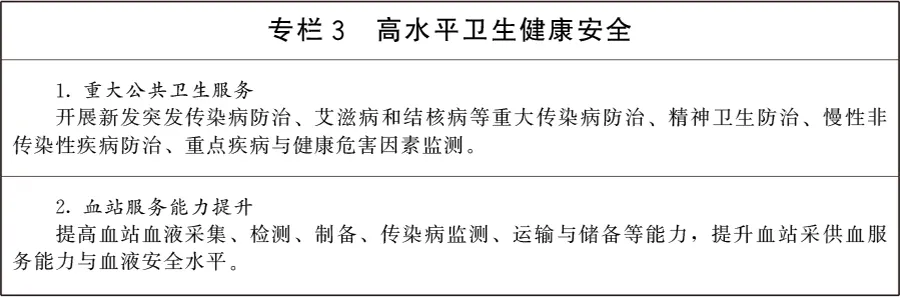
IV. Accelerate Development of a High-Quality, Efficient and Integrated Medical and Health Service System
(I) Optimize Functional Positioning and Layout of Medical Institutions
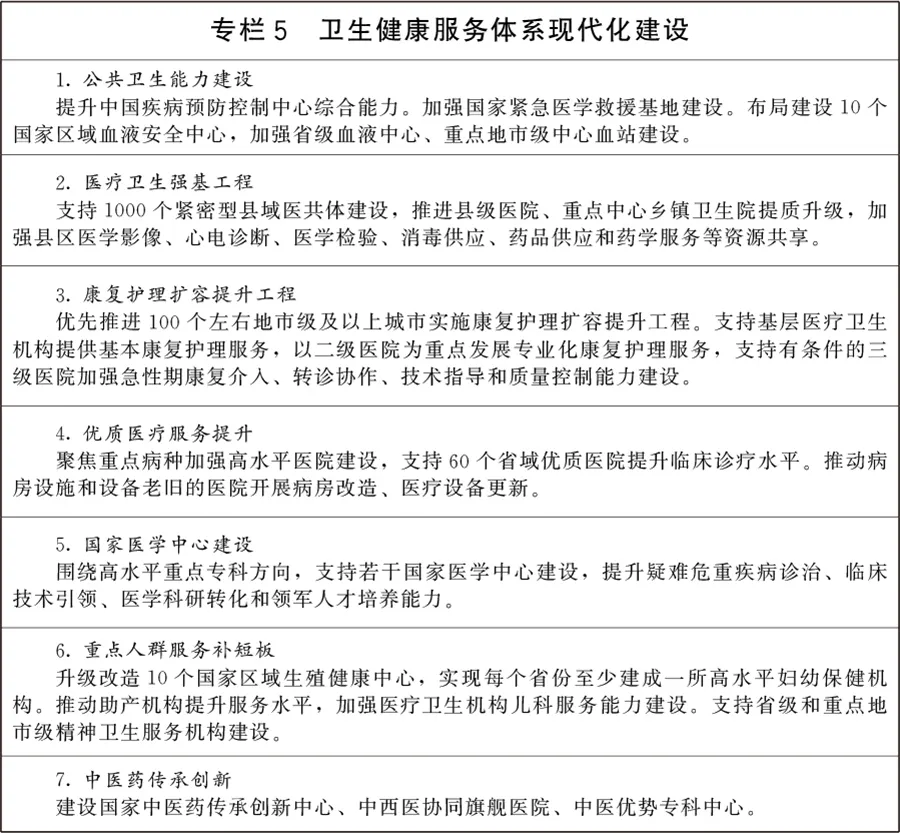
We will boost development of primary-level medical and health institutions, steadily develop secondary hospitals, and cap the scale of tertiary hospitals. We will optimize the layout of primary-level facilities based on local conditions, develop key central township health centers to drive surrounding areas, further improve urban community health service systems, and form a 15-minute access circle for basic medical and health services. We will expand medical functions of township health centers and community health service centers in densely populated towns to lift service quality. Urban secondary and county-level hospitals will be supported to develop under-supplied services including rehabilitation, nursing, mental health, pediatrics, geriatrics and palliative care. Hospitals undertaking national medical centers, national clinical research centers and national regional medical center tasks, as well as provincial and higher hospitals, will focus on referral, consultation and inpatient care for critical and complex illnesses, and upgrade treatment and research capabilities.
(II) Rationalize Allocation Standards for Medical and Health Resources
Medical and health resources will be allocated rationally based on population characteristics, health demands and regional disparities. We will strengthen the health workforce and narrow gaps in resource distribution between urban and rural areas, regions and disciplines. We will optimize equipment allocation for medical institutions and coordinate deployment of large medical devices. We will guide and constrain the bed allocation of public hospitals, banning unplanned construction and illegal debt-financed expansion of public hospitals.
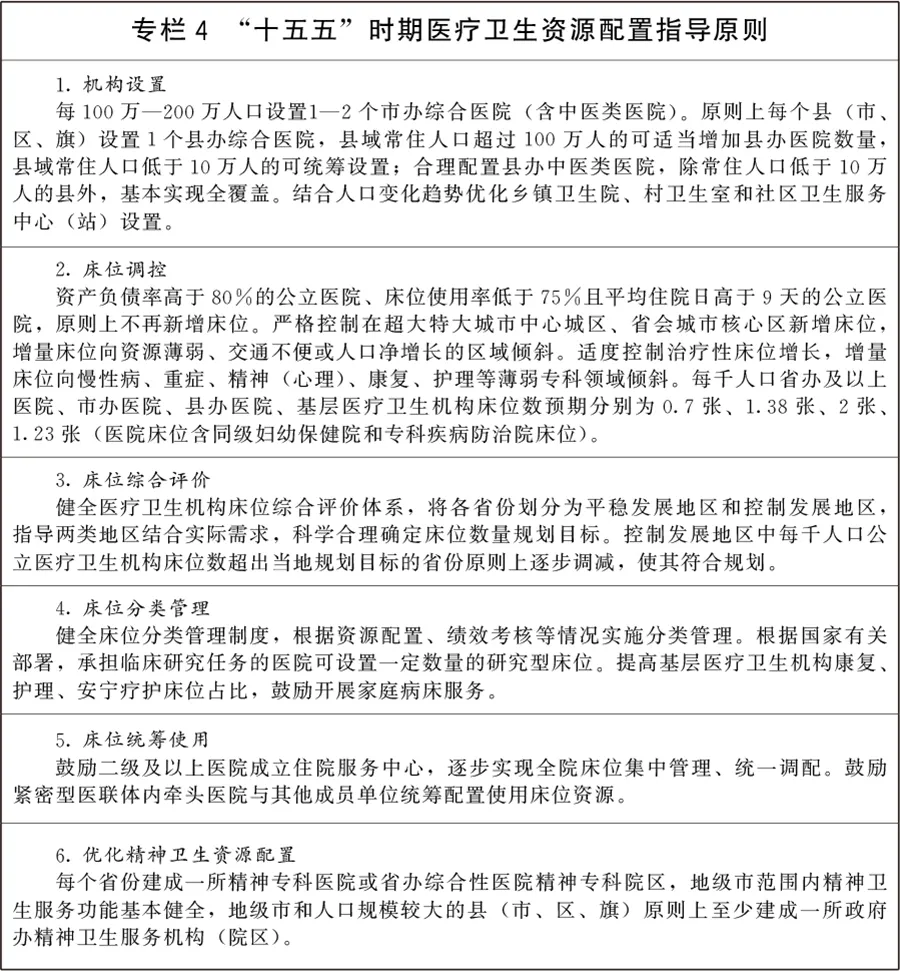
(III) Launch the Primary Medical Capacity Improvement Program
We will continue the High-Quality Primary Medical Services Campaign, ensuring over 95% of township health centers and community health service centers meet service capacity standards, and raising the proportion of medical visits handled at primary-level institutions. We will reasonably expand the range of medicines stocked at primary facilities, improve regular mobile medical services to cover all resource-weak regions, and implement two-way personnel mobility between lead hospitals and member institutions within compact county-level medical consortiums via county-managed township staffing and township-hired village staffing models. Retired senior medical staff will be encouraged to serve at primary levels. We will sustain targeted training programs for rural free medical students and village doctors, and organize standardized qualification examinations for general practitioners working in villages. Training programs for primary health personnel will be optimized to boost primary-level nursing, TCM and pharmaceutical services, with a moderate increase in mid-to-senior professional technical posts at primary institutions.
(IV) Roll Out Rehabilitation and Nursing Capacity Expansion and Upgrade Program
We will build a rehabilitation and nursing service network led by secondary hospitals, supported by primary-level institutions, guided by tertiary hospitals and supplemented by other medical bodies, expanding the supply of rehabilitation, nursing and palliative care services. Medical schools will be encouraged to strengthen rehabilitation medicine disciplines, standardize residency training for rehabilitation physicians, and scale up training for rehabilitation nurses and therapists, targeting 0.7 rehabilitation physicians and 1.6 rehabilitation therapists per 10,000 people.
(V) Build a Modern Public Health System
We will implement a modernization program for disease prevention and control systems, pilot municipal disease prevention and control consortiums, improve the public health laboratory network, and speed up standardized laboratory construction for disease control institutions. A tiered diagnosis and treatment system for infectious diseases will be developed. We will build national regional public health centers based on existing institutions, consolidate and upgrade core port public health capabilities, and establish a modern port public health system. A comprehensive emergency medical rescue system will be developed, emergency medical teams will be strengthened, emergency training for various scenarios will be delivered, and regular drills will be organized.
(VI) Develop a High-Quality Medical Service System
We will give full play to national medical centers to elevate China’s clinical medicine to world-class standards. We will upgrade national regional medical centers to extend high-quality medical resources to central, western and northeastern regions. Focusing on key diseases, we will support connotative development and clinical capacity improvement of high-level hospitals, strengthen weak specialties at the provincial level, deepen integration of medical education and clinical practice, and improve the capacity and training quality of residency training bases. We will refine maternal, child and elderly health service systems, continue the Pediatric and Mental Health Service Initiative, improve the mental health service system, and support eligible primary-level institutions to set up mental health outpatient clinics. A sound occupational health service network will be built; cities and counties without dedicated occupational disease prevention and control institutions will deliver occupational health services via existing medical bodies. We will refine the TCM service system and promote integrated Chinese and Western medicine, and advance the reform and development of special care hospitals.
V. Foster New Drivers for High-Quality Development of Medical and Health Undertakings
(I) Cultivate High-Level Innovative Talents
We will accelerate the training of strategic scientists, leading professionals and high-caliber innovative teams in medical and health fields, implement high-level medical talent programs, and cultivate interdisciplinary strategic talents integrating clinical practice, disease prevention and management to enhance scientific decision-making and emergency response capacities for public health crises. We will launch public health talent training support programs to nurture strategic public health professionals, and carry out the Qihuang Program for distinctive TCM talents to cultivate high-level integrated Chinese and Western medicine experts and core professionals trained in Western medicine with supplementary TCM expertise.
(II) Accelerate Medical and Health Scientific and Technological Innovation
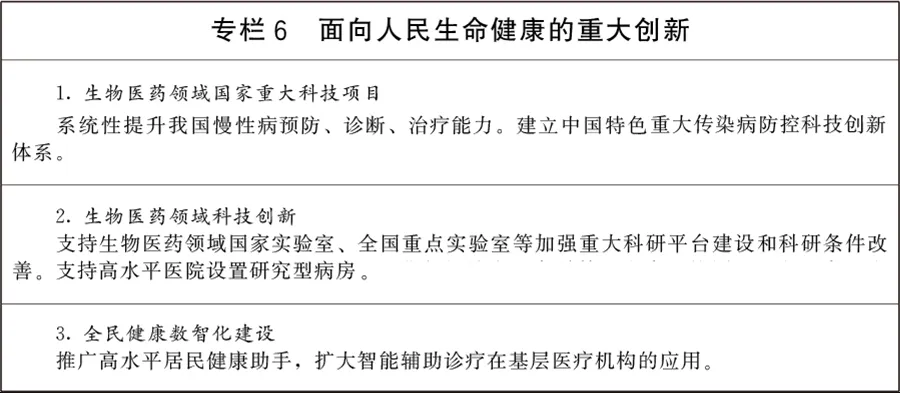
We will improve the medical and health innovation system, optimize the layout of innovation platforms and bases, cultivate national strategic scientific and technological forces, and strengthen research capacity of high-level medical institutions. Resource sharing mechanisms among medical institutions will be established, and scientific data sharing will be advanced in accordance with the law. We will deepen basic research in health fields, adhere to demand and problem-oriented research, refine mechanisms for identifying major scientific and technological tasks and coordinated implementation, launch national major science and technology special projects for biomedicine, and coordinate national key R&D programs. We will advance research on pathogenesis, pharmaceuticals, vaccines, medical devices and brain-computer interfaces, support qualified enterprises to lead research projects, and facilitate the commercialization of scientific and technological achievements. We will implement an action plan for high-quality development of medical and health academic journals.
(III) Advance Digital and Intelligent National Health Development
We will promote data sharing across medical care, medical insurance and pharmaceuticals, build a national cross-provincial platform for shared intelligent health test and imaging results, enabling real-time access to medical images, mutual recognition of test results and coordinated public health information. Strict standards will be enforced for information security and privacy protection. Residents will be able to access real-time home page data from their electronic health records. We will build intelligent application systems within compact county-level medical consortiums, support key regions to build high-quality medical datasets and trusted data spaces, construct national pilot bases for AI medical applications, and orderly deploy digital and intelligent technologies in auxiliary diagnosis, precision medicine, health management, medical insurance services and elderly care for the disabled.
(IV) Promote the Inheritance and Innovative Development of Traditional Chinese Medicine
We will strengthen protection of traditional TCM knowledge, launch inheritance and development programs for intangible cultural heritage of traditional medicine, sustain the TCM culture promotion project, and improve the TCM culture communication system. We will advance excavation and transformation of TCM preparations and classical prescriptions, deepen basic TCM research, and leverage modern science to interpret TCM mechanisms of action. We will refine the TCM standard system, carry out the New Era Divine Farmer Herbal Exploration Initiative, and accelerate the global outreach of TCM.
(V) Accelerate High-Quality Upgrading of the Health Industry
We will provide full-chain support for the development and application of innovative drugs and medical devices, streamline review and approval for innovative drugs and clinically urgent medicines, improve the comprehensive clinical evaluation system for innovative drugs, and support their clinical use. We will speed up R&D and application of cell and gene therapy drugs, novel antibodies, new vaccines, nucleic acid drugs and radiopharmaceuticals, boost R&D, production and deployment capacity for emergency vaccines and medicines, and expand the variety of pediatric medicines. We will deepen integration of medical and engineering research, ramp up support for core technologies, components and complete equipment of high-end medical devices, and empower the entire pharmaceutical industrial chain with artificial intelligence. Mechanisms for medical insurance to support high-quality development of innovative drugs and medical devices will be improved, alongside updated catalogs of innovative medicines.
We will guide and standardize the development of private hospitals. Social forces will be encouraged to establish non-profit medical institutions in under-supplied sectors such as rehabilitation and nursing to diversify health services. Private hospitals will be guided to clarify functional positioning, improve operational management, conduct standardized practice in accordance with the law, and lift service quality, advancing their specialized, branded and chain-based development.
We will expand and upgrade health consumption by launching special health consumption promotion initiatives, developing nutrition and health catering projects, and encouraging the production of food for special medical purposes and health food. New service formats such as health check-ups will be cultivated, and smart elderly care products for chronic disease management and daily care will be developed. The assistive rehabilitation device industry will be expanded to upgrade rehabilitation and recuperation services. We will steadily open the medical sector wider to the outside world, expand pilot wholly foreign-owned hospitals, and prudently launch international medical service pilots. Commercial health insurance will be deeply integrated with health management, with more new insurance products covering health intervention, special medical services and innovative drugs. Hainan Free Trade Port and other regions will be supported to develop health consumption.
VI. Deepen Health-Centered High-Efficiency Governance
(I) Boost the Effectiveness of Patriotic Health Campaigns
We will research and formulate regulations on patriotic health campaigns, develop healthy cities and towns, conduct comprehensive environmental improvement, and strengthen integrated vector control. Focusing on key populations, major diseases and prominent health issues, we will fully implement the Healthy China Initiative. We will build healthy villages, innovate working methods, leverage village/neighborhood committees’ public health committees and community grid management, and integrate health management into grassroots governance. We will accelerate the establishment of a health impact assessment system to systematically evaluate health impacts of economic and social development plans, major policies and key projects.
(II) Promote Coordinated Development and Governance of Medical Care, Medical Insurance and Pharmaceuticals
We will deepen reform of public hospitals oriented to public welfare, strengthen operational safeguards for county and primary-level medical institutions, and advance reform of medical and health public institutions. A regular dynamic adjustment mechanism for medical service prices will be maintained. We will implement the "two allowances" policy to reasonably set public hospital salary levels, grant independent internal distribution authority to public hospitals, reflect differences between posts, balance allocations across departments, and tilt compensation toward understaffed specialties in high public demand. Public hospitals operated by state-owned enterprises and other entities will advance reforms in line with requirements.
We will deepen reform of the medical security system, consolidate and expand basic medical insurance coverage, refine mechanisms for financing and benefit adjustment, and basically realize provincial-level pooling of basic medical insurance funds. We will advance reform of medical insurance payment methods, gradually develop a unified national catalog of medical service items and medical consumables covered by medical insurance, optimize the use of surplus funds, improve differentiated payment policies for medical institutions at different tiers, reduce out-of-pocket burdens for insured residents, and raise the efficiency of medical insurance funds. We will refine health financing mechanisms to effectively curb unreasonable growth of medical expenses, keeping the proportion of personal health expenditure in total health spending steadily declining.
We will advance reform of the drug supply guarantee and administration system, improve the national pharmaceutical policy framework, strengthen drug supervision centered on safety and quality, consolidate and refine the national essential medicine system, update the national essential medicine catalog in a timely manner, guarantee essential medicines for special populations, and improve monitoring, early warning and tiered response mechanisms for drug shortages. Medical insurance drug payment standards will be refined, alongside centralized procurement policies for medicines and medical consumables.
All regions will learn and promote the Sanming medical reform experience tailored to local conditions. We will strengthen organizational leadership and coordinated advancement of medical reform, align development goals, policy coordination, information connectivity and regulatory linkage under the health-first orientation. Local principal officials will take direct charge of medical reform, with deputy officials coordinating the three-pronged reform of medical care, medical insurance and pharmaceuticals, and strengthen coordinated evaluation of key medical reform policies.

(III) Improve the Comprehensive Supervision System for the Medical and Health Sector
We will strengthen comprehensive supervision over medical service quality and safety, institutional operations and medical practitioners, and advance cross-departmental data sharing and joint law enforcement. We will standardize practice of medical institutions and medical workers and reinforce industry self-regulation. Intelligent and embedded supervision based on electronic medical records will be rolled out, and a health supervision information platform will be refined to form a closed-loop supervision system. We will properly guard against and defuse debt risks of public hospitals and ensure workplace safety in the health sector.
(IV) Enhance Medical Humanistic Care
We will improve systems for medical social workers and volunteer services, encourage medical institutions to employ medical social workers, and provide patient support services including guidance for medical visits. Doctor-patient communication will be strengthened, and long-term mechanisms for resolving medical disputes will be refined. Information disclosure mechanisms for medical institutions will be improved, and safe hospital development will be fully advanced. We will strengthen work conduct and medical ethics among health personnel, deliver training on medical humanities, carry forward the spirit of combating SARS and the great anti-epidemic spirit, encourage lofty professional ethics, and foster a clean, upright and positive industry environment. Medical workers will be cared for, creating a social atmosphere that respects medical professionals.
(V) Strengthen Legal Safeguards for Medical and Health Work
We will improve the legal system for health, advance formulation and revision of health laws and regulations, and launch an action plan to upgrade health standards. We will innovate legal publicity and education, integrate legal training into medical school education, residency training, new staff orientation and daily work, and explore incorporating legal practice capacity into assessments for medical practitioners’ qualification and promotion to raise their legal literacy.
(VI) Promote Building a Global Community of Health for All
We will continuously improve bilateral and multilateral cooperation mechanisms, strengthen professional personnel training, and take an active part in formulating international rules for health. We will deepen health cooperation under the Belt and Road Initiative and advance high-quality development of the Health Silk Road. We will scale up foreign medical aid, expand assistance to public health and traditional medicine, optimize the structure and layout of foreign medical teams, and jointly build China-Africa joint medical centers. We will deepen paired hospital cooperation between China and Africa, and carry out small yet impactful programs such as the Brightness Campaign and Care for Hearts Campaign. We will build international exchange and cooperation bases for health based on high-level domestic hospitals to conduct global clinical research and innovation, frontier technology application and international medical services. High-quality overseas TCM centers will be developed, and China’s health stories will be well told to the world.
VII. Strengthen Organization and Implementation
We will uphold the Party’s overall leadership over all stages and aspects of medical and health work. All regions and departments shall implement this Plan in light of local conditions together with the Outline of the Healthy China 2030 Initiative, and conduct evaluations on Healthy China development. The National Health Commission will strengthen overall coordination, monitor and evaluate Plan implementation together with relevant departments, optimize tasks and measures based on real-world conditions, and summarize typical local experience and effective models in a timely manner. Major issues shall be reported to the CPC Central Committee and the State Council in accordance with official procedures without delay.
One Chart to Understand the National Health Plan for the 15th Five-Year Plan Period

Source: Official Website of the National Health Commission, Healthy China
✅ Click "Read More" to access the full text

Prev Deepen Integration of Industry, Academia, Research and Medicine | Municipal Health Commission Visits Four National-Level Research Platforms Alongside Guangzhou Medical Expo
Next Circular on Further Improving Centralized Procurement of Medical Equipment in Public Medical and Health Institutions (with Supporting Policy Interpretation)
相关推荐
- Bay Area Connects Globally, Innovation Drives Health | 2026 Guangzhou Medical Expo Invites You to Attend This Grand Event 2026-05-22
- 2026 Guangzhou Medical Expo Scheduled for August! Building the Core Engine for the Greater Bay Area's Healthcare Industry. 2025-11-07
- Full-chain Empowers Industrial Innovation! The 2025 Guangzhou Medical Expo Successfully Concludes Today 2025-08-24
- Grand Opening of 2025 Guangzhou Medical and Health Industry Expo: Jointly Paint a New Blueprint for Health and Play the March of Industrial Endeavor 2025-08-22
-
Exhibition Overview
Exhibition IntroductionOrganizationExhibition RangePost exhibition reportExhibition Promotion -
Media Center
Exhibition DynamicsIndustry NewsExhibition PhotoExhibition VideoPartner -
Audience Center
Visit ScheduleVip Registration -
Exhibitor Center
invitationWhy To ExhibitScheduleExhibition Floor PlainBooth Reservation -
Concurrent Events
Forum activitiesRoadshowSigning -
Business Travel Service
City IntroductionExhibition HallSightseeingTraffic Guide -
Contact Us
About UsContact Us
Copyright Guangdong Silver Age Health Industry Co. Ltd.
粤ICP备2021159608号-6
 粤公网安备44010502003694号
TEL:+86 020-38109036 E-mail:eld@eldexpo.com Add:Yinfa Chain Global Selection Center, No. 192 Kaitai Avenue, Huangpu District, Guangzhou.