286days left

Circular on Further Improving Centralized Procurement of Medical Equipment in Public Medical and Health Institutions (with Supporting Policy Interpretation)
Author:广州医博会
Time:2026-07-15
Reader:588
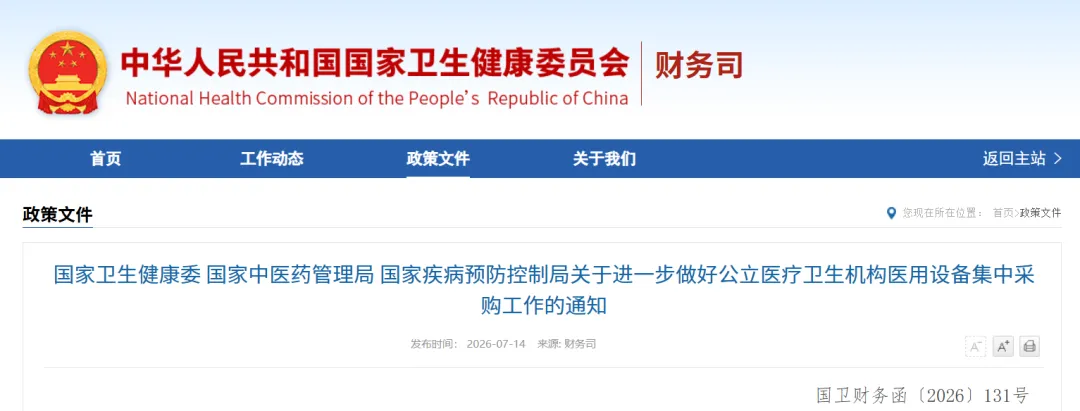
Health Commissions, Administrations of Traditional Chinese Medicine, and Bureaus of Disease Prevention and Control of all provinces, autonomous regions, municipalities directly under the Central Government, and the Xinjiang Production and Construction Corps:
Promoting the centralized procurement and administration of medical equipment in public medical and health institutions is an important decision and deployment made by the CPC Central Committee and the State Council, as well as a key measure to strengthen clean governance in the medical and health sector. To advance the full implementation of this work in a standardized and orderly manner, we hereby notify relevant matters upon consultation with the Ministry of Finance.
I. Scope of Implementation
All public medical and health institutions nationwide shall conduct departmental centralized procurement when purchasing medical equipment included in the departmental centralized procurement catalog with funds subject to budget administration in accordance with provisions. Exceptions shall apply to emergency procurement under special circumstances including severe natural disasters, public health emergencies and other force majeure events. Procurement of Class A and Class B large medical equipment shall be subject to prior configuration approval.
II. Applicable Legal and Institutional Regimes
Centralized procurement of medical equipment shall comply with the provisions of government procurement laws and regulations and implement relevant government procurement policies. Competitive procurement methods such as public bidding shall be adopted in principle. Work concerning government procurement budget and plan management, information statistics and other matters shall continue to be implemented in accordance with existing administrative provisions and budget administration levels.
III. Working Principles
(I) Clear, Restricted and Mutually Restrictive Powers of Administration, Execution and Supervision
We shall design sound institutions, rationally allocate authority, implement multi-dimensional supervision, and build a mutually restrictive mechanism to ensure standardized, orderly, clean and efficient procurement activities.
(II) Appropriate Technology, Quality First and Reasonable Price
Medical equipment purchased by medical and health institutions shall align with their functional positioning and tiered configuration requirements. Major factors including quality, price and service shall be incorporated into procurement evaluation criteria to realize premium quality at fair prices. While leveraging the scale effect of centralized procurement to eliminate inflated prices, we shall strengthen the full-life-cycle cost mindset, take into account demand for consumables, maintenance and other supporting services, adopt scientific evaluation methods, and guard against cutthroat homogeneous competition.
(III) Law-Based, Fair, Impartial and Open & Transparent Operations
We shall strictly enforce the Government Procurement Law, standardize procurement activities, and refrain from setting discriminatory or preferential clauses. Information shall be disclosed to the public as required, a transparent pricing mechanism for centralized procurement shall be accelerated, fair competition shall be safeguarded, and development of a unified national market shall be promoted.
IV. Core Tasks
(I) Organize Departmental Centralized Procurement at Multiple Administrative Levels
National-level Centralized ProcurementThe National Health Commission shall continue to organize centralized procurement of Class A large medical equipment for all public medical and health institutions nationwide. Equipment featuring high degree of personalized customization, requiring supporting infrastructure design and construction, and subject to separate registration procedures on a unit-by-unit basis shall be incorporated into the departmental centralized procurement catalog for centralized procurement when conditions permit.
Provincial-level Centralized ProcurementProvincial health administrative departments shall organize centralized procurement of Class B large medical equipment for all public medical and health institutions within their jurisdictions, and gradually include other medical equipment with large capital investment and insufficient market competition into the scope of centralized procurement. At least one round of centralized procurement shall be completed by the end of 2026. In principle, at least one round of centralized procurement shall be organized in the first half of each year, and the procurement frequency may be increased as needed.
Prefecture-level Centralized ProcurementWe shall advance centralized procurement of medical equipment at the prefecture level in a steady and orderly manner. By the end of June 2027, each province shall identify at least one prefecture to carry out pilot work and complete one round of centralized procurement.
(II) Develop a Filing Database for High-value Medical Equipment
The National Health Commission shall establish a transparent pricing mechanism for centralized procurement of medical equipment, strengthen IT and AI support, and advance the development of a national filing database for high-value medical equipment (referring to medical equipment covered by centralized procurement hereinafter). All provincial health administrative departments shall timely upload and file procurement information on high-value medical equipment. Specific work arrangements will be issued separately.
V. Key Working Links
(I) Formulate Departmental Centralized Procurement Catalogs
The National Health Commission and provincial health administrative departments shall formulate their respective departmental centralized procurement catalogs for medical equipment, file them with finance departments at the same level as required, and organize implementation upon filing. Pilot prefectures shall, in a prudent and progressive manner prioritizing simple items first, submit draft prefectural departmental centralized procurement catalogs to provincial health administrative departments for review, complete relevant formalities as required, and launch implementation thereafter. Centralized procurement of Class B large medical equipment that falls under provincial jurisdiction shall not be delegated to prefectural authorities.
(II) Identify Implementing Agencies
Health administrative departments shall select one qualified non-profit institutional legal person under their jurisdiction with strong professional capacity and standardized internal control as the centralized procurement implementing agency to conduct centralized procurement on their behalf. The implementing agency shall sign entrustment agreements with public medical and health institutions, and organize centralized procurement independently or entrust procurement agencies to carry out such work in accordance with agreed procurement tasks. Health administrative departments may adjust implementing agencies in a timely manner as work requires.
(III) Strengthen Procurement Demand Administration
Public medical and health institutions shall bear primary responsibility for procurement demand administration, formulate and submit procurement demands in compliance with the Measures for the Administration of Government Procurement Demands, and strengthen internal control and risk management throughout the formulation and fulfillment of procurement demands.
Centralized procurement implementing agencies shall provide professional support to public medical and health institutions in defining procurement demands. Procurement packages shall be classified and divided scientifically and rationally based on institutional demands without simplistic one-size-fits-all arrangements. Procurement documents shall fully and accurately reflect procurement demands and be released upon written confirmation by the public medical and health institution concerned.
(IV) Intensify Review of Abnormally Low Bids in Evaluation
We shall fully implement relevant requirements issued by the Ministry of Finance on addressing abnormally low bids in government procurement, specify circumstances triggering reviews of abnormally low bids in procurement documents, conduct standardized reviews, timely handle irregularities, and truthfully record review opinions and results.
(V) Improve Reporting Regimes
Health administrative departments shall establish reporting systems for major centralized procurement incidents and annual work performance. Provincial health administrative departments shall submit their provincial centralized procurement work plans to the National Health Commission for filing by the end of June 2026. Annual work reports shall be submitted to the National Health Commission by the end of December each year.
VI. Work Requirements
(I) Raise Awareness
All local authorities shall fully recognize the significance of standardized centralized procurement of medical equipment for strengthening clean governance in the medical and health sector, cutting procurement costs and patients’ medical burdens, and elevating medical service quality, to ensure all work is conducted in a law-based, high-quality, efficient, steady and orderly manner. We shall uphold the public welfare nature of medical and health undertakings, strictly enforce requirements to curb unregulated expansion of tertiary public hospitals, align equipment configuration with institutional functional positioning, and prohibit the purchase of large medical equipment through debt financing.
(II) Strengthen Overall Planning and Deployment
Provincial health administrative departments shall establish a sound organizational and management system for centralized procurement of medical equipment, designate lead divisions, formulate work plans, improve institutional frameworks, refine working mechanisms, and guide prefectural-level centralized procurement. Inter-provincial and inter-prefectural procurement alliances are encouraged to fully leverage the scale benefits of centralized procurement.
(III) Reinforce Implementation Support
Local authorities shall guide and supervise implementing agencies to strengthen internal control and risk management for centralized procurement, allocate adequate staffing, improve professional competence and expertise, and intensify legal education and integrity training. For Class A large medical equipment not yet covered by national centralized procurement, provincial health administrative departments and implementing agencies under relevant jurisdictions shall guide medical institutions to conduct independent procurement in full compliance with laws and regulations.
(IV) Enforce Strict Supervision and Administration
Centralized procurement of medical equipment shall be subject to supervision by finance departments at the same level, and shall cooperate with external oversight including audit and disciplinary inspection. Full play shall be given to internal audit and financial supervision to strengthen routine whole-process oversight and promptly identify and address emerging irregularities.
(V) Conduct Sound Policy Interpretation
Local authorities shall carry out prudent policy interpretation and guidance during the deployment and implementation of centralized procurement, and respond to public concerns in a timely manner.
This Circular shall take effect upon issuance. Any outstanding matters related to centralized procurement of medical equipment shall be handled in accordance with prevailing government procurement administrative provisions. The Circular of the Ministry of Health on Further Strengthening Centralized Procurement Administration of Medical Devices (Wei Gui Cai Fa〔2007〕No. 208) shall be abolished simultaneously. Where provisions of the Circular of the General Office of the Ministry of Health on Issuing the Trial Specifications for Centralized Procurement of Class A Large Medical Equipment (Wei Ban Gui Cai Fa〔2012〕No. 96) and the Circular of the General Office of the Ministry of Health on Issuing Guiding Opinions on Centralized Procurement of Class B Large Medical Equipment (Wei Ban Gui Cai Fa〔2013〕No. 7) are inconsistent with this Circular, this Circular shall prevail.
National Health Commission of the People’s Republic of ChinaNational Administration of Traditional Chinese MedicineNational Administration of Disease Prevention and ControlMay 20, 2026
Policy Interpretation of the Circular on Further Improving Centralized Procurement of Medical Equipment in Public Medical and Health Institutions
I. Background for Issuance
To standardize and advance centralized procurement of medical equipment, improve the efficiency of fund utilization in public medical and health institutions, strengthen clean governance in the medical and health sector, safeguard people’s health rights and interests, and boost high-quality development of health undertakings, this Circular is formulated in accordance with the Government Procurement Law and other relevant laws and regulations, combined with the realities of the health sector, and on the basis of summarizing practical experience from national-level centralized procurement of Class A and Class B large medical equipment and provincial-level centralized procurement of Class B large medical equipment across the country.
II. Key Arrangements
(I) Procurement Catalogs
All public medical and health institutions nationwide shall conduct departmental centralized procurement when purchasing medical equipment included in national, provincial and prefectural departmental centralized procurement catalogs. The National Health Commission and provincial health administrative departments shall formulate their respective departmental centralized procurement catalogs for medical equipment, file them with finance departments at the same level as required, and organize implementation upon filing. Prefectural health administrative departments shall formulate departmental centralized procurement catalogs, obtain approval from provincial health administrative departments, complete filing procedures with local finance departments as stipulated, and launch implementation thereafter.
(II) Multi-level Procurement
Class A large medical equipment (primarily high-end radiotherapy equipment) shall be included in the national departmental centralized procurement catalog and continue to be procured centrally by the National Health Commission. Equipment featuring high personalized customization, requiring supporting infrastructure design and construction, and subject to separate unit-by-unit registration procedures (mainly heavy ion and proton radiotherapy systems) shall be temporarily excluded from centralized procurement catalogs.
Class B large medical equipment (including PET/MR, PET/CT, laparoscopic surgical systems and conventional radiotherapy equipment) shall be included in provincial departmental centralized procurement catalogs. Other medical equipment with large capital investment and insufficient market competition shall be gradually incorporated into centralized procurement scope and procured centrally by provincial health administrative departments. Medical equipment outside national and provincial departmental centralized procurement catalogs shall be subject to centralized procurement catalog formulation and implementation by prefectural health administrative departments following a prudent, progressive approach prioritizing simple items first.
(III) Specific Implementation Procedures
Health administrative departments shall select one qualified institution with strong professional capacity and standardized internal control from their affiliated entities as the centralized procurement implementing agency to conduct centralized procurement; government centralized procurement agencies may also be designated as implementing bodies. Public medical and health institutions bear primary responsibility for procurement demand administration and shall submit procurement demands as required. Centralized procurement implementing agencies shall classify and divide procurement packages scientifically and rationally based on institutional demands, and organize centralized procurement independently or entrust procurement agencies to carry out such work.
All localities shall complete at least one round of centralized procurement of Class B large medical equipment by the end of 2026. By the end of June 2027, each region shall identify at least one prefecture to launch pilot centralized procurement of medical equipment and complete one full round of procurement.
(IV) Guiding Philosophy
We adhere to the principle of premium quality at fair prices and foster a full-life-cycle equipment cost management mindset. Evaluation criteria and methods shall be formulated rationally to cover both one-off procurement costs including quality and price, and long-term expenses such as consumables, reagents and after-sales maintenance services. Reviews of abnormally low bids shall be strengthened to avoid cutthroat homogeneous competition, shifting the sole objective of centralized procurement from cost savings to comprehensive performance integrating quality and reasonable pricing.
A national filing database for high-value medical equipment centralized procurement shall be developed. Combined with government procurement information disclosure channels, a nationwide transparent pricing mechanism for high-value medical equipment will be established to ensure open, fair and impartial centralized procurement.
(V) Implementation Requirements
All local authorities shall raise ideological awareness, strengthen overall planning and deployment, reinforce implementation support, enforce strict supervision and administration, conduct sound policy interpretation, and advance all relevant work steadily and orderly.
Source: Official Website of the National Health Commission of the People’s Republic of China

Prev Circular of the State Council on Issuing the National Health Plan for the 15th Five-Year Plan Period
Next Notice for Application | Training Camp on Medical-Engineering Integration Innovation and Commercialization
相关推荐
- Bay Area Connects Globally, Innovation Drives Health | 2026 Guangzhou Medical Expo Invites You to Attend This Grand Event 2026-05-22
- 2026 Guangzhou Medical Expo Scheduled for August! Building the Core Engine for the Greater Bay Area's Healthcare Industry. 2025-11-07
- Full-chain Empowers Industrial Innovation! The 2025 Guangzhou Medical Expo Successfully Concludes Today 2025-08-24
- Grand Opening of 2025 Guangzhou Medical and Health Industry Expo: Jointly Paint a New Blueprint for Health and Play the March of Industrial Endeavor 2025-08-22
-
Exhibition Overview
Exhibition IntroductionOrganizationExhibition RangePost exhibition reportExhibition Promotion -
Media Center
Exhibition DynamicsIndustry NewsExhibition PhotoExhibition VideoPartner -
Audience Center
Visit ScheduleVip Registration -
Exhibitor Center
invitationWhy To ExhibitScheduleExhibition Floor PlainBooth Reservation -
Concurrent Events
Forum activitiesRoadshowSigning -
Business Travel Service
City IntroductionExhibition HallSightseeingTraffic Guide -
Contact Us
About UsContact Us
Copyright Guangdong Silver Age Health Industry Co. Ltd.
粤ICP备2021159608号-6
 粤公网安备44010502003694号
TEL:+86 020-38109036 E-mail:eld@eldexpo.com Add:Yinfa Chain Global Selection Center, No. 192 Kaitai Avenue, Huangpu District, Guangzhou.